
Winter University of Engineering Sciences
Winter University of Engineering Sciences is an international project implemented at Peter the Great St. Petersburg Polytechnic University as part of the national project «Youth and Children.» The project brings together engineering and technical students from Russia and abroad, providing a unique opportunity to develop professional competencies, implement engineering projects, and strengthen international cooperation.
Main goal: Strengthening ties and expanding collaboration between young engineers, developing their competencies in digital technologies and artificial intelligence.
Key organizers:
- SPbPU Advanced Engineering School «Digital Engineering.»
- Supported by the Ministry of Science and Higher Education of the Russian Federation and other partner universities.
Unique features:
- Learning through practice. The Winter University is more than just lectures. It’s intensive project work, where theory is immediately applied to solving real-world problems.
- Team project work. Forming international teams to solve real-world industry problems.
- Collaboration with industrial partners. Classes are taught by SPbPU faculty and experts from leading companies.
- Modern laboratories. Workshops are held in high-tech laboratories at the SPbPU School of Industrial and Applied Sciences, such as CompMechLab®.
We invite engineering students from all over the world to spend two unforgettable winter weeks in St. Petersburg, one of Russia’s most beautiful cities. The Winter University of Engineering Sciences at SPbPU is a unique international project where you can immerse yourself in the world of cutting-edge technologies, apply your knowledge in practice, and find like-minded people to bring your ideas to life.
«School of Artificial Intelligence and Digital Technologies» educational program was implemented as part of the «School of Engineering Sciences» project. The program ran from April 17–30, 2023. The project aims to strengthen ties between young engineers and deepen cooperation within the Union State of Russia and Belarus, with the support of the Ministry of Science and Higher Education of the Russian Federation, the Social Center, SPbPU International Services, and the SPbPU Applicant Services Center. More than 100 students from Russian and Belarusian universities completed the program.
Fields of study:
- Autonomous and driverless transport;
- Computer-aided engineering;
- Topology-based design and 3D printing;
- VR, digital transformation, and lean manufacturing.
The interactive game in the digital transformation module is truly something special. I’ve never seen such a high level of organization and presentation anywhere. The very fact that Polytechnic University developed such an interactive project with excellent design, engaging interactive characters, and an incredibly complex concept is astounding. The game feels like a project from a game development studio. PIS SPbPU engineers are developing truly large-scale projects that can compete even on the global stage,
Sevastyan Bury, Brest State Technical University (BSTU)
A huge thank you to all the module instructors! The lectures and practical sessions were very engaging. The simulation game added incredible interactivity to the educational program. We were able to experience ourselves as responsible for the digital transformation of a thermal power plant and gain a practical understanding of what digital transformation of an enterprise entails. A special thank you to Fedor Tarasenko, a research engineer at the Engineering Center, for a very interesting and useful presentation during the pitch session!
Stanislav Grigoriev, Chuvash State University (ChuvSU)
The Winter University of Engineering Sciences «New Scientific Horizons» 2024 was held from November 25 to December 6, 2024, at the Advanced Engineering School «Digital Engineering» (AES SPbPU). The event was supported by the Ministry of Science and Higher Education of the Russian Federation, the Federal State Autonomous Institution «Sociocenter,» the Polytechnic University’s international services, and the SPbPU Applicant Service Center.
The Winter University was attended by 170 young people representing 44 universities in Belarus, Kazakhstan, Kyrgyzstan, Uzbekistan, Armenia, Tajikistan, China, South Africa, Iran, and India. Fifty Russian students also participated from 19 universities and institutes in Moscow and the Moscow Region, St. Petersburg, Nizhny Novgorod Region, Karelia, Khabarovsk Krai, Kaliningrad Region, Irkutsk Region, Novosibirsk Region, Astrakhan Region, and Samara Region.
The 2024 Winter University program included three equally important parallel engineering tracks, which included educational modules and project-based lab units: «Sigma» and «Tau» for Russian-speaking students, and «Epsilon» for English-language students.
The engineering championship brought together all Winter University students to determine the best designers. Teams built catapults from scrap materials and competed in throwing their «projectiles» the longest. Team «Alpha» from Kyrgyzstan proposed the best catapult design with the longest throw.
Testimonials:
I really enjoyed studying at the Winter University in St. Petersburg. I met students from Russia, South Africa, and China and learned how engineers are trained in other countries. The engineering championship was my favorite. Using simple materials, we created a real catapult that was able to launch a projectile 8 meters. We are very happy with our victory. We had the chance to visit the city’s beautiful palaces and historical museums, board the cruiser Aurora, and even see the bridges open. Thanks to all the organizers. I look forward to returning to St. Petersburg and the Polytechnic University,
Namazbek Munduzbaev, M. M. Adyshev Osh Technological University
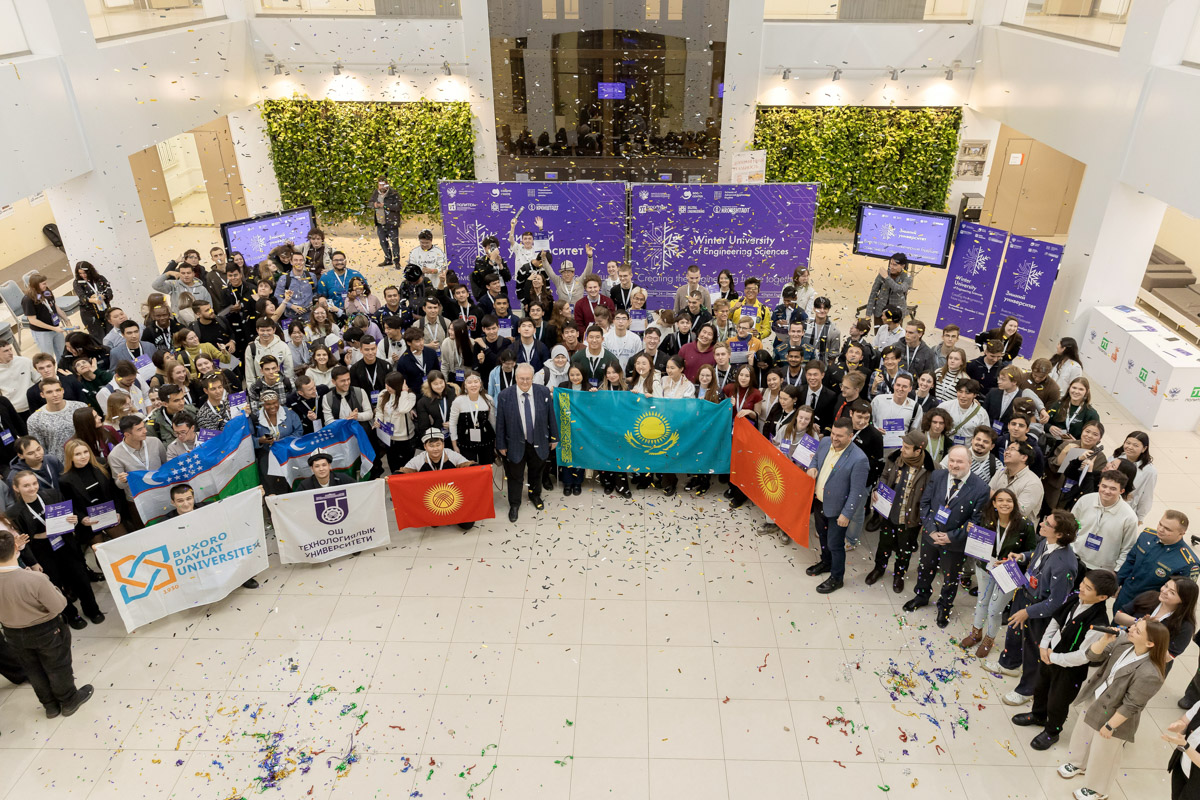
Winter University of Engineering Sciences «Artificial Intelligence and Digital Technologies» took place in December 2025. Participants included over 200 third- and fourth-year undergraduate students in engineering and technology from 44 universities in Russia, Europe, Asia, and Africa. The geography of participants expanded significantly, with students and young scientists from Russia, Kazakhstan, Kyrgyzstan, Belarus, Uzbekistan, Armenia, Tajikistan, South Africa, China, Iran, India, Serbia, Cuba, and Indonesia.
The «Artificial Intelligence and Digital Technologies» program was implemented with the support of the Ministry of Science and Higher Education of the Russian Federation at SPbPU’s Advanced Engineering School «Digital Engineering» and consisted of technical modules, lectures, master classes, business games, an introductory Russian language course for English-speaking students, and a cultural and entertainment program.
A key feature of the 2025 program was the active involvement of industrial partners. The «Engineer» track included a module titled «Modern Engineering in High-Tech Industries» led by specialists from the Winter University’s industrial partner, the Kronstadt Engineering Education Center. The module was supervised by Igor Perevozchikov, Head of the Change Lab at the Kronstadt Engineering Center. Students not only immersed themselves in the theory of modern engineering and learned about real-life processes in the partner’s production facilities and laboratory complexes, but also completed a number of practical tasks: they built 3D models based on their own measurements, conducted a materials analysis, and reverse-engineered a component.
In the Digital Transformation and Lean Manufacturing Lab, young engineers were introduced to the concept of lean manufacturing, explored its approaches and tools for reducing waste, experienced the role of modern enterprise managers in the «LEAN Manufacturing» computer simulator, and carried out a digital transformation of the enterprise using the «Digital Transformation of an Enterprise» digital simulator. The «Supply Chain Management» educational module introduced Winter University participants to the «New Industrial Challenge» computer simulator. In a competitive game format, students had to effectively manage production and the supply chain, focusing on market trends, to achieve the best economic results.
The simulators were developed by experts from SPbPU’s Advanced Engineering School «Digital Engineering» and are based on the CML-Bench®.EDU Digital Platform, which represents a separate area of the Digital Platform for the development and application of CML-Bench® digital twins for training and competency assessment.
As part of the «Aircraft Wing Aerodynamics» module, students participated in the «Energy Strategy: Power System Management» case game, designed to introduce the fundamentals of the energy industry through a game-like approach. The game mechanics are based on the principle of business simulation. Participants were tasked with building an optimal national power system, taking into account both economic efficiency and environmental requirements. The Winter University also hosted an Engineering Championship to determine the best designers. Teams built catapults from scrap materials and competed in throwing their «projectiles» the farthest. First place went to a team from Armenia (Russian-Armenian University), second place to a team from Kazakhstan and Uzbekistan (Kostanay Social and Technical University named after Academician Zulkharnay Aldamjar, Tashkent State Technical University named after Islam Karimov), and third place to a team from India and Indonesia (Savitribai Phule Pune University, University of Indonesia).
Testimonials:
I think the program was an amazing experience, both culturally and educationally. The connections we made with different cultures, the way we learned about Russia’s history and sights together with Iranians, Cubans, Indians, Chinese, South Africans, and Uzbeks... It was a once-in-a-lifetime opportunity. Plus, St. Petersburg is beautiful, and I definitely have to see it this summer—it’s one of the most beautiful cities I’ve ever been to. The lectures really broadened my thinking and motivated me to try my hand at innovation and startups, for example. The competitions, using the technologies we’d learned the day before, also helped me learn faster, achieve more, and practice teamwork. Overall, I hope to come back here again, both to the city and to the program, and I highly recommend it!
Miloš Panjevas, University of Belgrade
Thank you so much for everything. I really enjoyed this program and expanded my knowledge. I will definitely recommend it to other students.
Khoiakbar Ostankulov, Andijan State Technical Institute
The energy system creation game was very interesting; the time flew by. Thank you so much to the organizers! Even I, a thermal power engineering student, would have thought it would have been boring, considering I’ve been studying this for four years, but no. I really enjoyed this format.
Elina Denezhkina, SPbPU