
3D printing without joints: SPbPU has found a way to connect non-weldable metals
A research team led by Anatoly Popovich, Director of the Institute of Machinery, Materials and Transport at SPbPU has developed a technology for multimaterial 3D metal printing of complex products.
With its help, it is possible to create nodes and parts from several (up to four) alloys in one technological cycle. This significantly saves money and time. The size of one volumetric unit of printing of a specific material is less than one millimeter, which allows them to be programmed literally on a microscale.
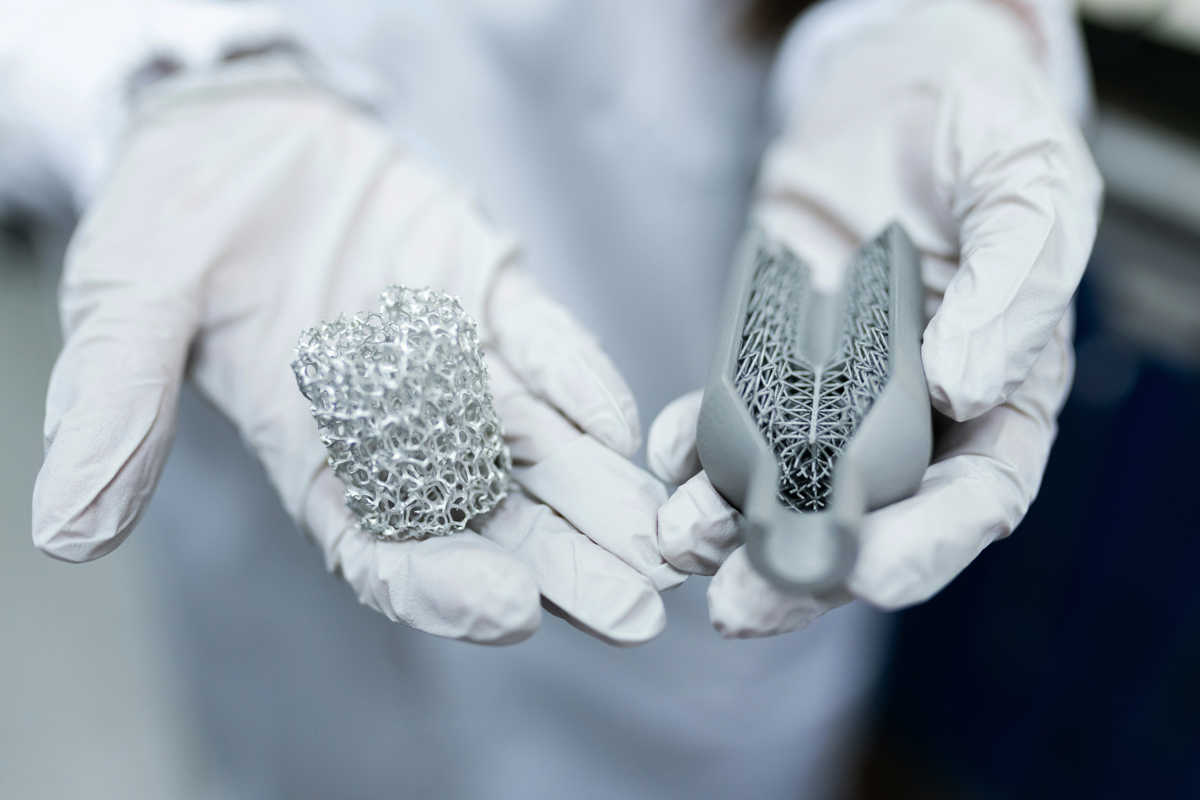
A new technology developed by polytechnic scientists allows for the creation of a part by programming the necessary set of properties through the formation of zones made from materials with required characteristics. This eliminates sharp transitions between layers of different materials. The composition and properties change gradually from one metal to another, preventing the formation of defects at the junctions. This makes it possible to combine even initially unweldable materials, in particular aluminum and steel.
Today, specialists at SPbPU have already tested over 20 materials and their combinations, including titanium and aluminum alloys, as well as shape memory alloys. Engineers have created a prototype of a small-scale combustion chamber: the inside is made of heat-resistant bronze, the outer shell is a load-bearing nickel alloy, and between them is a fine mesh structure that efficiently dissipates heat. Thanks to the new technology, the manufacturing time of a product is significantly reduced. While the traditional cycle takes months (making the inner shell, milling it, and then welding external elements to it), the new development enables everything to be done in a single technological cycle. Including subsequent mechanical surface finishing, it takes only a few days.
Another product is a gear, where vibration damping is required inside and increased hardness on the outside to prevent wear. The improvement of mechanical properties is achieved by defining a complex transition shape from one material to another. This condition can also be programmed and obtained in the finished product.
Thus, the development by SPbPU not only enables stronger connections but also saves costs and time in their production.