
Artificial intelligence and neural manifolds: a new approach to the study of Alzheimer's disease in a mouse model
Scientists at Peter the Great St. Petersburg Polytechnic University (SPbPU) have presented an innovative system for automatically tracking mouse behavior and parallel analysis of the activity of their neurons in the hippocampus, a key part of the brain associated with memory and spatial orientation.
Traditionally, studying animal behavior requires hours of watching videos and manual analysis. The new work uses the modern neural network YOLO-Pose, which automatically and accurately recognizes the poses and actions of mice: running, resting and self-care. This significantly speeds up the research process and increases its efficiency.
The technology of recording the activity of neurons using miniature microscopes mounted on the mouse’s head in conditions of free movement helps to directly link behavior with the work of the brain. By studying data on hundreds of neurons, scientists form so-called «neural manifolds» — unique multidimensional models that display the dynamics of neural ensembles during various behavioral states.
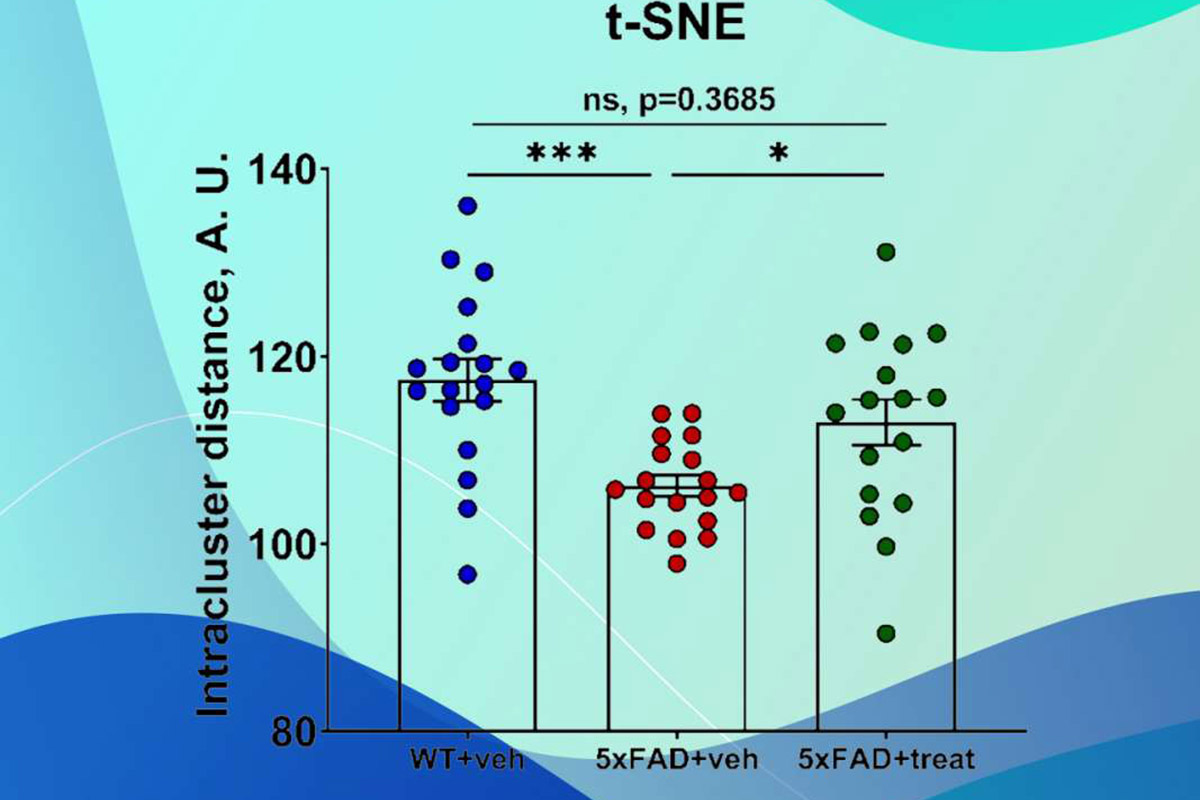
Using mice with a genetic model of Alzheimer’s disease (5xFAD), the researchers found serious abnormalities in the structure of neural manifolds in sick animals. Their organization is especially noticeably distorted during active movement, which indicates communication failures between neurons in the hippocampus.
It is important that the experiment includes testing of a potential drug. The drug partially restored the normal patterns of neural manifolds in mice. This proves the high potential of using such an analysis to evaluate the effectiveness of new drugs against neurodegenerative diseases.
An innovative approach combining artificial intelligence and modern methods of neurophysiology expands the possibilities of studying brain activity in natural conditions. There is a deeper understanding of how Alzheimer’s disease affects the functioning of neural networks as a whole, and not just individual cells.
In addition, the proposed method can accelerate the development and testing of effective drugs, as well as find applications in other areas of neuroscience, where it is important to trace the relationship between behavior and brain activity. This study opens a new stage in the study of complex brain diseases and demonstrates how modern technologies are changing approaches in fundamental and applied science.