
For the first time in the world, St. Petersburg scientists have localized Alfven oscillations in the plasma of a spherical tokamak
For the first time in the world, Russian scientists have succeeded in accurately determining the location of special waves in plasma — Alfven oscillations. The discovery provides a key to solving one of the main problems of safety and efficiency of controlled thermonuclear fusion, which is especially important in the development of energy sources of the future. The experiment was carried out on a unique spherical tokamak Globus-M2 at the A.F. Ioffe Institute of Physics and Technology.
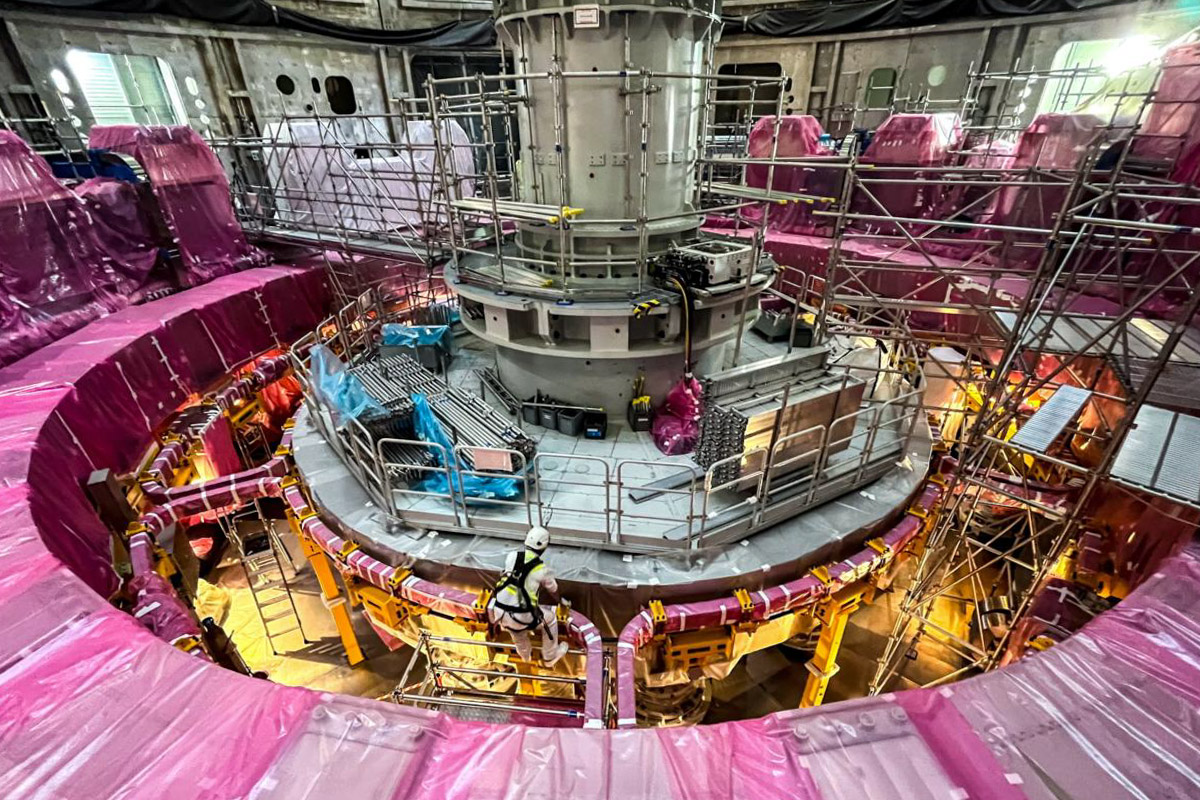
Alfven oscillations are a special type of waves that occur in a plasma (ionized gas) in the presence of a magnetic field. With a small disturbance, the particles and the magnetic field itself begin to oscillate together like a string through which a wave runs. These fluctuations propagate along magnetic lines and are observed both in laboratory installations and in space. For the theoretical description of these oscillations, Swedish physicist Hannes Alfven won the Nobel Prize in Physics in 1970.
In laboratory conditions, Alfven oscillations are studied on toroidal (doughnut-shaped) installations for magnetic plasma confinement, for example, on tokamaks. This shape makes it possible to keep hot plasma with temperatures up to 100 million degrees Celsius inside using magnetic fields, preventing it from coming into contact with the walls. Tokamaks create conditions similar to the processes inside the Sun to generate energy through thermonuclear fusion. Alfven oscillations inside tokamaks have a double effect. On the one hand, they contribute to the transfer of energy and particles, but on the other hand, they can lead to heat loss or the appearance of instabilities that are dangerous for plasma to escape from the magnetic field and subsequent melting of the walls of the structure. Therefore, the study of the physical processes inside such installations is particularly important. Existing theoretical models and computer calculations in the world described how these oscillations should behave, but it had not previously been possible to experimentally test the theory in difficult conditions of a real toroidal installation.
For the first time in the world, St. Petersburg scientists have obtained two important results in the study of Alfven oscillations in the plasma of a spherical tokamak Globus-M2 at the Ioffe Institute of Physics and Technology.
First, we experimentally discovered exactly where Alfven oscillations arise and exist inside the toroidal installation. The measurements were carried out using Doppler backscattering (DOR) microwave diagnostics developed by scientists at the Polytechnic University. This diagnosis made it possible to measure the amplitude of the electric field of Alfven oscillations directly in the field of their development. Secondly, we found out that different types of Alfven oscillations and their harmonics can have different localization," said Alexander Yashin, Candidate of Physico-Mathematical Sciences, Head of the High-temperature Plasma Diagnostics Scientific Laboratory at the SPbPU Institute of Physics and Mechanics.
Since the plasma temperature inside the tokamak is too high, the use of standard contact sensors for measurements is limited.
The Doppler backscattering method uses microwave radiation scattered on inhomogeneities in the plasma. This allows remote and local measurement of key parameters. For reliability, the Doppler backscattering data was compared with the data of magnetic probes, which are traditionally used to study the dynamics of Alfven oscillations, but cannot provide information about their localization or the local value of their amplitude. The comparison showed that different methods give consistent results," said Arseniy Tokarev, a researcher at the Scientific Laboratory of Advanced Methods for Studying Spherical Tokamak Plasma at the St. Petersburg State University Institute of Physics and Mechanics.
Alfven oscillations lead to large losses of fast particles in the plasma. And their role in thermonuclear fusion is difficult to overestimate. Firstly, only they have enough energy to converge and interact, resulting in a thermonuclear fusion reaction. Secondly, they give part of their energy to slower particles, while increasing the temperature of the plasma. To create an efficient and safe thermonuclear fusion, it is important to minimize the loss of high-energy particles. For example, according to calculations, the experimental thermonuclear reactor ITER in France, created by an international scientific team, will withstand no more than two percent of the loss of fast particles. Alfven fluctuations can cause much more significant losses. Therefore, the experimental data on the localization of Alfven oscillations in plasma, obtained by St. Petersburg scientists, are a valuable contribution to the development of global thermonuclear energy.
The research was supported by the Ministry of Science and Higher Education of the Russian Federation as part of the state assignment in the field of science under project No. FSEG 2024 0005 using the Federal Center for Collective Use «Materials Science and Diagnostics in Advanced Technologies» at the A.F. Ioffe Institute of Physics and Technology, which includes a unique scientific installation «Spherical Tokamak Globus-M».