
SPbPU scientists have created a removable multilayer fire protection system for metal structures
Researchers at St. Petersburg Polytechnic University and specialists from NPC PROMIZOL have proposed an alternative to traditional plasters and paints — a removable multi-layer flame retardant cover that can be quickly installed and, if necessary, removed without damaging the structure. The new device can withstand fire for up to 4 hours, works even in the Far North and can be reused.
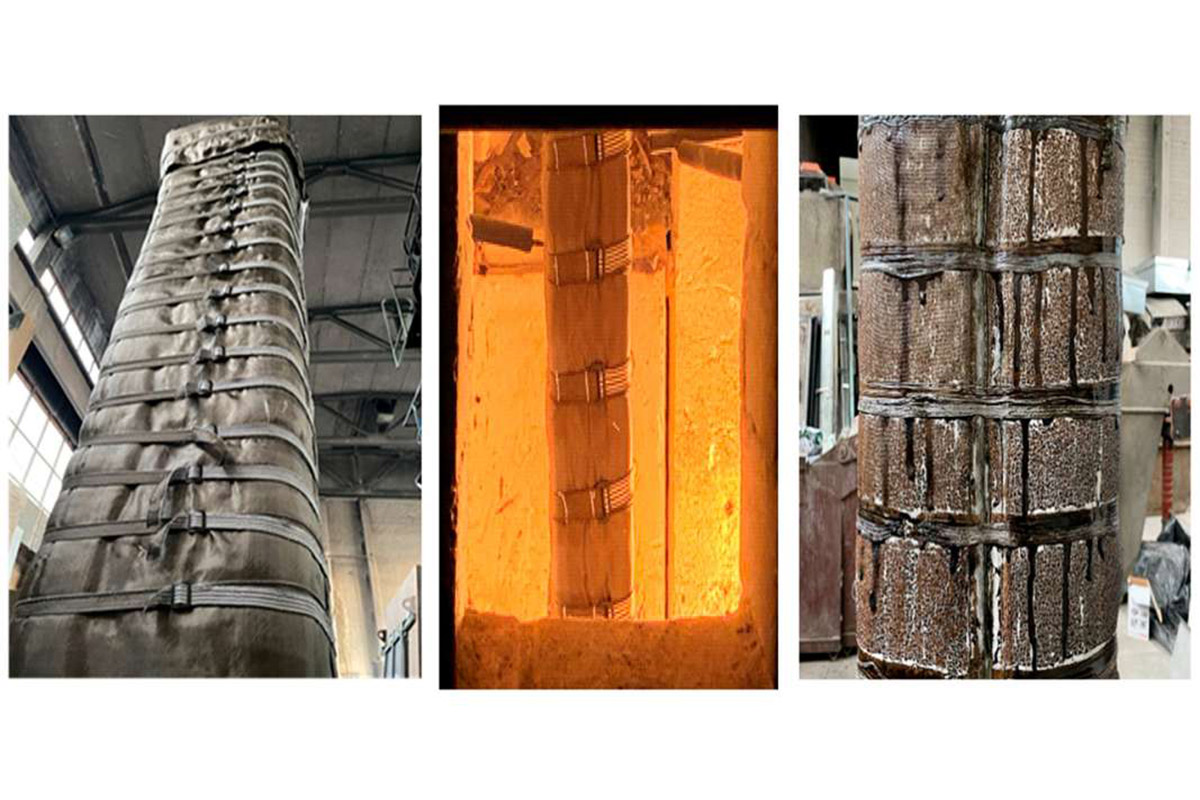
At oil and gas facilities, especially in the Arctic, the protection of metal structures from fire is critically important. In case of fire, steel loses its strength at 500°C and in a matter of minutes the support beams begin to collapse, which can lead to disaster. The situation is complicated by the climate: the air temperature is below −50°C, strong winds, cycles of freezing and thawing. Traditional methods do not work here: they crumble, require complex surface preparation, and most importantly, are not maintainable.
The new coating consists of basalt fiber, ceramic fabrics providing heat resistance and mechanical stability, reinforcing fiberglass, foil and heat-resistant threads. All this is assembled into a modular structure and fixed with fire-resistant tapes. Such a multilayer structure with a thickness of 15 to 50 mm works as a thermal barrier, slowing down the heating of the metal and preventing loss of bearing capacity.
The coating was tested on steel beams with sections I20 and I40, both under load and without it. The beams were fired in special furnaces in standard and hydrocarbon fire modes. After cooling, the coating retained its shape and properties, which means it can be reused — a rarity among flame retardant technologies.
Modular covers are already being used at real facilities in the Arctic. They can be quickly dismantled for revision, repair or replacement of structures — without losing their protective properties. This has an economic and operational effect, especially when working in hard-to-reach regions with a harsh climate.
Although the development was created for the needs of the Far North, the technology is universal and can be useful in industrial enterprises with a risk of hydrocarbon fires, in tunnels where quick installation and dismantling are important, as well as on temporary structures or during the modernization of old facilities.
Thus, SPbPU engineers proposed not just a new material, but a new approach to fire protection: removable, lightweight, heat-resistant, designed for real fires. This is a step towards a safe, adaptive and smart infrastructure — both in the Arctic and far beyond.