
April 12 — 65 years since the first human spaceflight
On April 12, 1961, at 9:07 AM, a launch vehicle with the Vostok-1 spacecraft lifted off from the Baikonur Cosmodrome. On board was 27‑year‑old pilot‑cosmonaut, Major Yuri Gagarin. He was about to accomplish what no one had ever done before: to orbit the Earth. This feat not only opened a new chapter in space exploration — it made our country a pioneer, whose name is forever linked to the breakthrough to the stars.
In honor of this event, Cosmonautics Day is celebrated in the USSR, and now in Russia, and throughout the world — Aviation and Cosmonautics Day. On April 7, 2011, the United Nations General Assembly officially proclaimed April 12 as the International Day of Human Space Flight.
Cosmonautics Day is a holiday not only for cosmonauts. It is rightfully celebrated by designers, scientists, engineers, ground service specialists — all those whose efforts make the conquest of the universe possible. It is a day of the triumph of human intellect, a day of recognition of the labor of thousands of people who drive science forward.
For Polytechnic University, Cosmonautics Day also means a great deal. The discoveries and developments of Polytech alumni and staff have become the foundation for future achievements in space exploration.
The theoretical foundation of modern rocket dynamics was laid by Ivan Vsevolodovich Meshchersky’s works “Dynamics of a Point of Variable Mass” and “Equation of Motion of a Point of Variable Mass in the General Case”.
Polytechnic student Alexander Shargei, at the age of 19, was the first to calculate the flight trajectory and landing scheme for a spacecraft on the Moon, and also prepared drafts for a future book titled “To Those Who Will Read, to Build”. He went down in history under the name Yuri Kondratyuk. His calculations later helped American astronauts land on the Moon — in recognition, a monument was erected to him at the Cape Canaveral spaceport in the USA.
In the 1920s—1930s, Polytech researchers actively studied the stratosphere:
- In 1925, Professor A. A. Friedman and pilot P. F. Fedoseenko reached an altitude of 7,400 meters;
- In 1933, stratospheric balloon envelope designer K. D. Godunov and pilot E. K. Birnbaum ascended in the stratospheric balloon “USSR 1” to an altitude of 19,200 meters;
- Graduate and postgraduate student of the Physics and Mechanics Department I. D. Usyskin was a crew member of the stratospheric balloon “Osoaviakhim 1”, which reached an altitude of 22,000 meters.
Starting in 1956, at the Department of Automatic Motion Control of the Leningrad Polytechnic Institute (LPI) named after M. I. Kalinin, under the leadership of Professor T.N. Sokolov, work was carried out to create a specialized computer for determining the trajectory parameters of space (orbital) objects and transmitting data via specialized communication channels to ground stations. As a result, the digital computers “Kvarts” and “Temp-1” were developed. “Kvarts” was used during the launch of the third Soviet artificial Earth satellite in May 1958.
On April 12, 1961, both “Kvarts” and “Temp-1” were used during Yuri Gagarin’s flight. Twenty-six employees of the Polytechnic department participated in the preparation and execution of the flight. For successfully supporting the mission, the development team was awarded orders and medals of the USSR. Yuri Gagarin’s instructor was test pilot, 1937 LPI graduate, and Hero of the Soviet Union M. L. Gallai.
In 1961, an Experimental Design Bureau was established at Polytechnic, headed by Taras Nikolaevich Sokolov (since 1975 — the “Impuls” Design Bureau), which created equipment for processing orbital data from artificial Earth satellites and developed control systems.
Among the Polytech alumni whose achievements determined the development of cosmonautics are:
- V. I. Kuznetsov — developer of the automatic flight control system for Yuri Gagarin on the Vostok spacecraft;
- S. N. Zernov — creator of the world’s first equipment for studying cosmic rays with data transmission to Earth via radio;
- S. A. Kosberg — one of the creators of the launch vehicle for lunar flights;
- E. A. Gailish — developer of radio-electronic components and systems for Soviet spacecraft.
- The names of four Polytech alumni — I. V. Meshchersky, N. A. Rynin, Yu. V. Kondratyuk, and S. A. Kosberg — are immortalized on the map of the Moon.
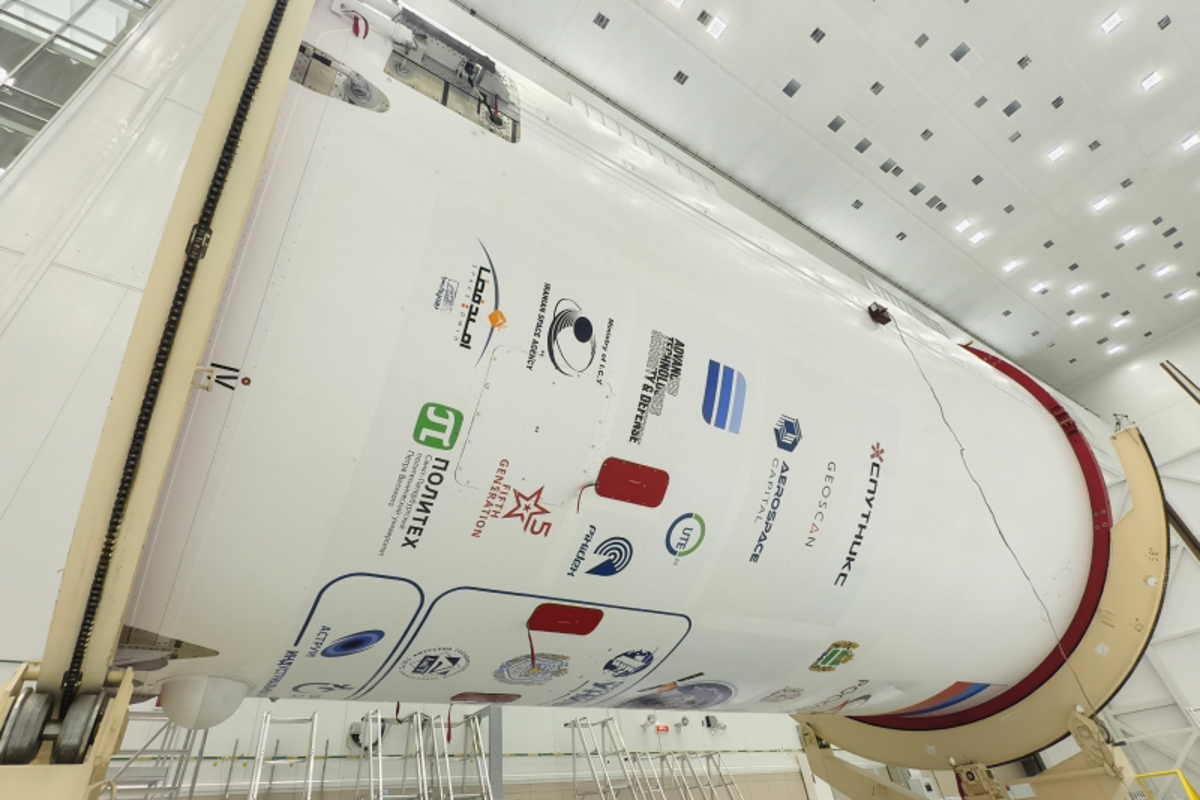
The traditions continue today. In 2016, the Higher School of Applied Physics and Space Technologies was established at SPbPU, which is now part of the Institute of Electronics and Telecommunications. A vivid confirmation of the relevance of our scientists' research is the launch on August 9, 2022, from the Baikonur Cosmodrome of 16 small spacecraft (CubeSats) as part of the Space Pi educational project, among which were two SPbPU nanosatellites developed at the Higher School of Applied Physics and Space Technologies of the Institute of Electronics and Telecommunications.
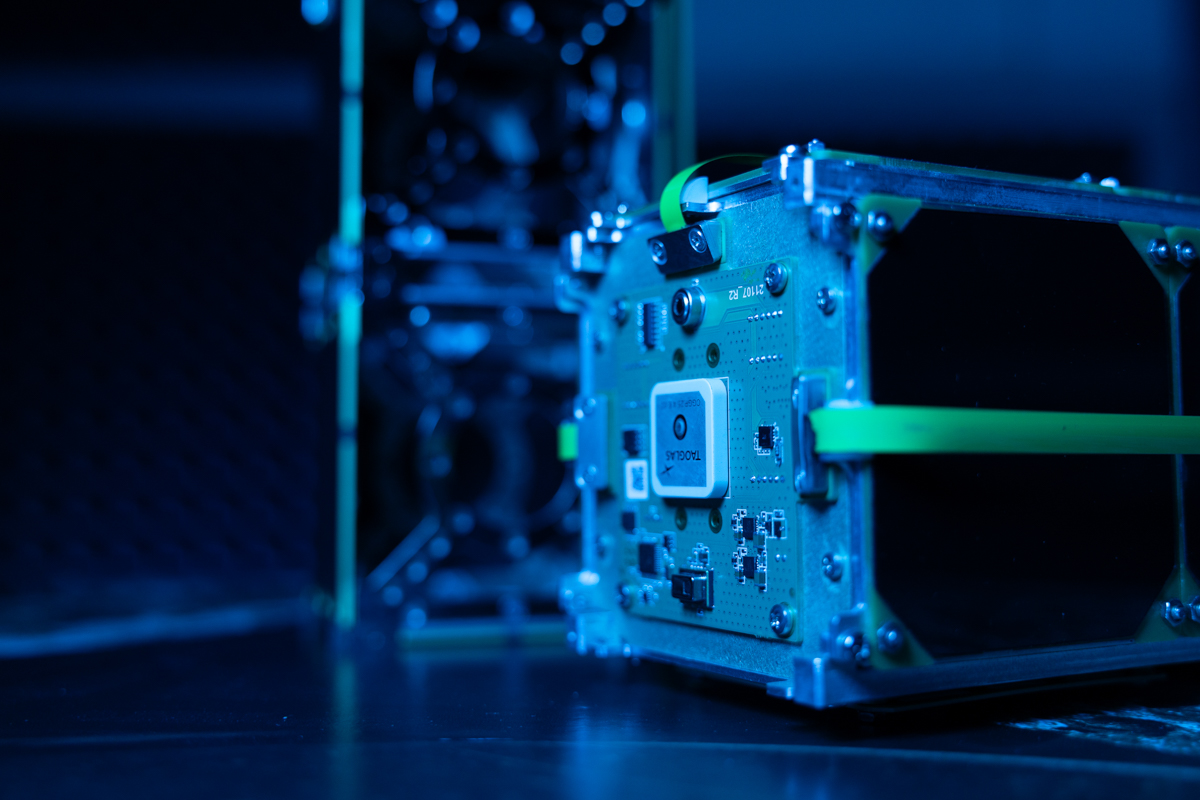
On June 27, 2023, the third SPbPU nanosatellite was launched into space.
On November 5, 2024, SPbPU launched two more nanosatellites into orbit.
In January 2026, the Institute of Electronics and Telecommunications and the Special Technology Center (STC) manufactured and launched into orbit the sixth nanosatellite as part of the Polytech Universe space constellation.
Once upon a time, almost all Soviet children dreamed of becoming cosmonauts. Polytech supports this desire in today’s schoolchildren by teaching them rocket modeling. Another launch of rockets designed under the guidance of SPbPU mentors will take place on the eve of Cosmonautics Day.